Motorcycle Tire Install Cost: Is It Worth Doing Yourself?
By Rabaconda Inc.
You're pricing out a new set of tires, and somewhere between the tire cost and the install quote, a question creeps in: could I just do this myself?
That's really two separate costs. The tire itself is one line item, and it varies a lot by brand, size and compound. This guide isn't about that one. It's about the other line item, the one that surprises people every time: what a shop charges to actually mount and balance the tire you just bought, and whether paying that fee over and over is still cheaper than owning the tools to ditch the dealer and swap tires on your own.
Short version: for most riders who change tires more than once a year, the math works out faster than you'd think. Here's the real breakdown.
Quick answer
On the lower end of pricing, shops typically charge $25-$40+ per tire if you bring in just the wheel, or $50-$100+ per tire if you bring in the whole bike. On the higher end, you could be looking at $125-$180 for a set of tires if you bring in just the wheels, and upward of $350 if you bring in the whole bike.
A home setup like the Rabaconda Street Bike Tire Changer and Wheel Balancer typically breaks even somewhere around 4-5 sets of tires, depending on what you'd otherwise be paying.
What shops actually charge to mount a motorcycle tire
Pricing varies by shop type, region and whether you're handing over just a wheel or the whole bike.
Bring-your-own-wheel, independent shop: Roughly $25-$40 per tire. This is the cheapest way to get a shop to do the job, but it requires you to already have the wheel off the bike, which means you're doing the labor-intensive part yourself, anyway.
Full-service, dealer or shop pulls the wheel: Roughly $50-$100 per tire once you factor in wheel removal, mounting, balancing and reinstallation. This is what most riders actually pay, since most riders aren't set up to pull their own wheel.
Multiply by two for a full set. Front and rear together, full-service pricing typically lands somewhere between $100-$200 depending on your bike, your market and whether your wheels are easy or difficult to access.
Larger touring wheels, wider rear tires and bikes with single-sided swingarms tend to land at the higher end of that range. A quick front tire swap on a naked bike tends to land at the lower end. Still, some larger shops/dealers may have higher rates and much of what you could be paying just depends on where you are and who your closest dealers/shops are.
The part that doesn't show up on the invoice
Cost isn't just the dollar amount on the receipt. It's also the appointment you have to schedule, the day you lose waiting or arranging a ride and the fact that your bike is sitting in someone else's shop instead of your garage. None of that shows up as a line item, but it's real, and it's part of why this question comes up in the first place.
Doing the math: when does owning your own setup pay off
Here's the comparison, using current pricing for the Rabaconda Street Bike Tire Changer ($739) and Motorcycle Wheel Balancer ($199), a combined $938 for a setup that handles both mounting and balancing at home. The below scenarios use middle-of-the-road pricing for each path, whether it’s bringing your wheels in to an independent shop or your whole bike in to a full-service dealer.
Scenario
Cost per set (2 tires)
Sets to break even on $938
Bring-your-own-wheel, independent shop
$75–$125
Roughly 9-10 sets
Full-service, dealer or shop pulls the wheel
$150–$250+
Roughly 4-5 sets
The honest comparison is the full-service line. If you're going to own the tools to mount and balance your own tires, you're also pulling your own wheel, which means the fee you're actually replacing is the full-service fee, not the discounted bring-your-own-wheel rate. On that basis, most riders break even somewhere in the 4-5 sets of tires.
Rabaconda's own numbers on the Street Bike Tire Changer put it at paying for itself after 3-4 sets of tires on its own, which tracks with the higher end of full-service dealer pricing on wider, harder-to-access wheels. Add the balancer to that math and the combined setup still pencils out within single digits of tire changes for most riders.
Where this pays off fastest:
Multiple bikes in the garage
Track day riders swapping tires by the weekend
High-mileage commuters and touring riders replacing rear tires often
Anyone who's ever had to reschedule a ride because the shop couldn't get to it for a week.
Where it takes longer: If you own one bike, ride casually and replace tires once every year or two, the break-even point is still real, it just arrives on a longer timeline. Even then, the tools carry a lifetime warranty and don't wear out or expire, so the investment isn't going anywhere while you wait for it to pay off. Plus, there's the satisfaction of picking up a skill for life, and the reputation that comes with it: you'll have riding buddies lining up for help on their next tire change, too.
Where Rabaconda fits in
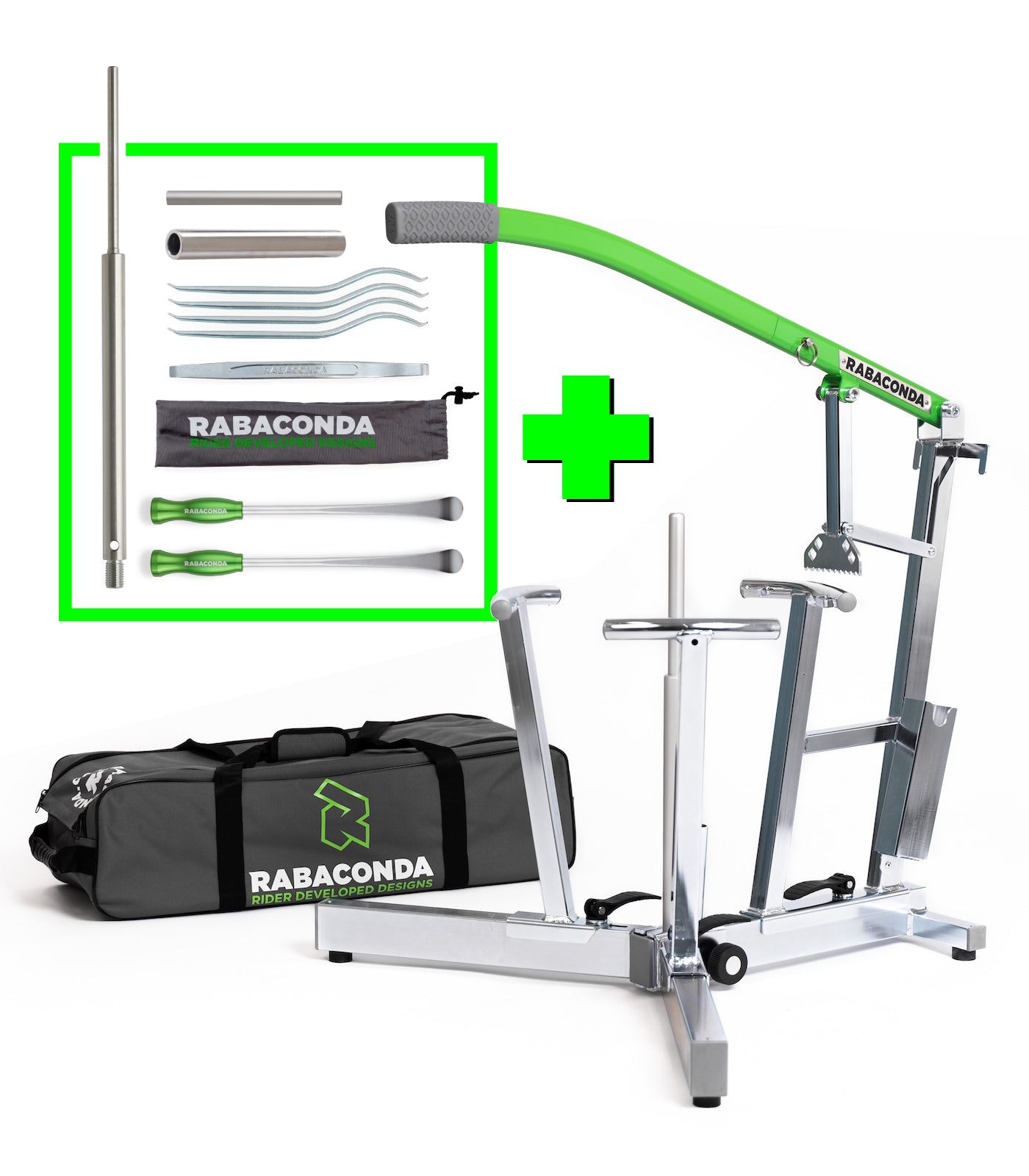
Once the math says yes, the next question is what to actually buy. Two tools cover the full job:
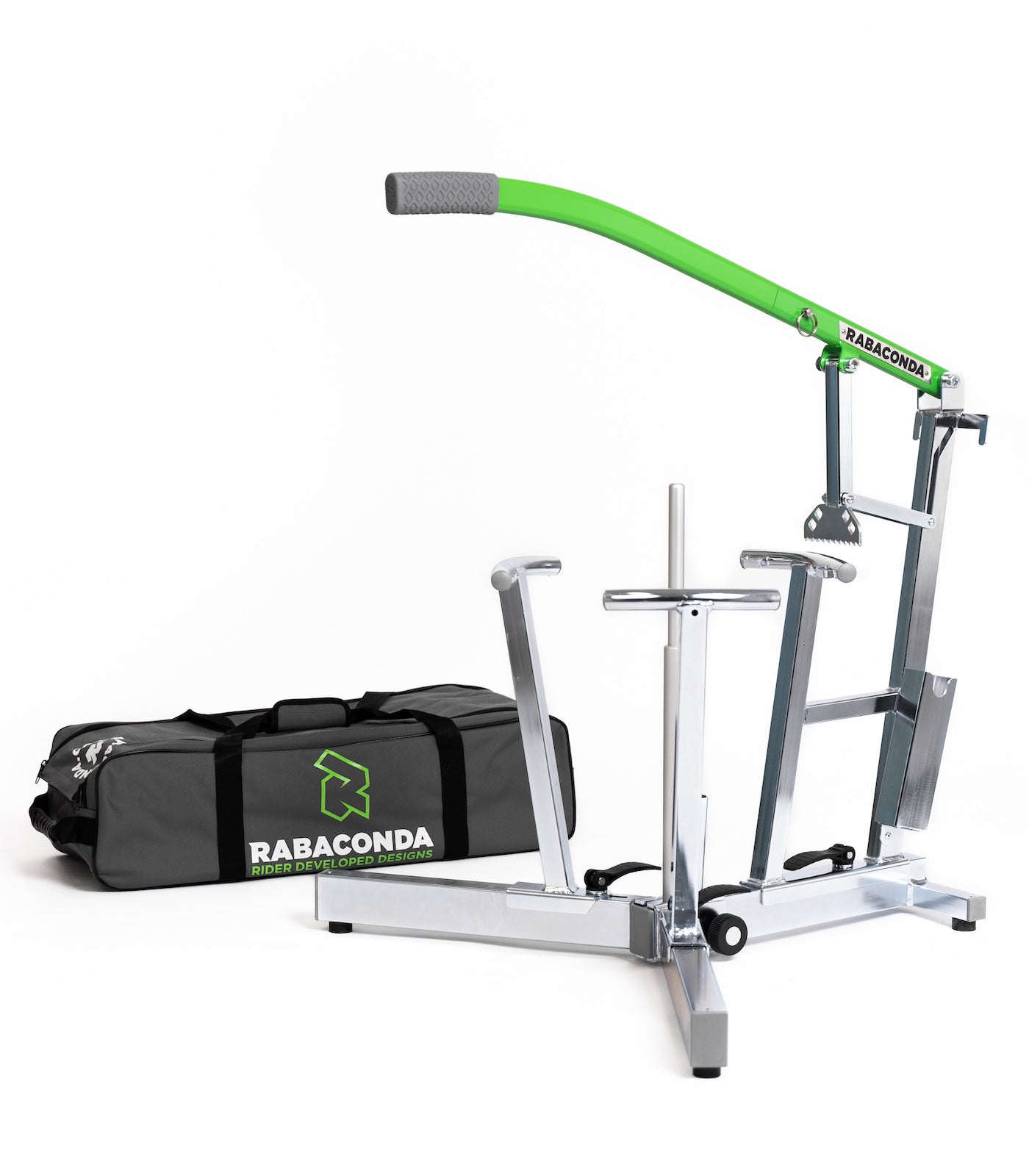
TheStreet Bike Tire Changer handles mounting and dismounting on 12-21 inch wheels, cast, forged or spoked, on tires up to 250mm wide, across sport bikes, cruisers, Harleys, touring bikes and adventure bikes. It breaks down into a carry bag, sets up in a 3×3 ft footprint and comes with a lifetime warranty.
The Motorcycle Wheel Balancer closes out the job. Low-friction sealed bearings and the HACS (hand-adjustable cone system) mean the wheel finds its true heavy spot instead of lying to you, and it mounts to the wall or packs into its own carry bag when you're done so it's not eating up bench space.
Together, they replace the exact service a shop charges you for: pull the wheel, mount the tire, balance it, done. The difference is you're doing it on your schedule, in your garage, as many times as you want, without spending your time and paying per visit ever again.
Frequently asked questions
How much does it cost to mount and balance a motorcycle tire?
Expect $25 to $40 per tire if you bring in just the wheel, or $50 to $100+ per tire for full service where the shop removes and reinstalls the wheel for you, and that’s just the minimum you should expect to pay. Larger wheels, wider tires and harder-to-access setups can push past that.
How many tire changes does it take to break even on a tire changer and balancer?
Using current pricing, most riders break even somewhere between 4-5 sets of tires when comparing against full-service shop rates.
Is it worth buying a tire changer if I only change tires once a year?
The break-even point takes longer on a once-a-year schedule, but the tools carry a lifetime warranty and don't lose value sitting in the garage. For multi-bike owners or frequent riders, the payoff comes much faster. And don't forget the side benefit: you're picking up a skill for life, and probably a few new favors owed by riding buddies.
Does the cost to mount a tire include balancing?
Not always. Some shops quote mounting and balancing as one combined price; others charge separately. Confirm what's included before you compare quotes.
Is a motorcycle tire changer hard to use?
No. Both the Street Bike Tire Changer and Wheel Balancer are designed for tire 'newbies' in mind. Both tools are designed with tire newbies in mind, with clear instruction manuals and video walkthroughs covering every step of the process. Most riders get comfortable with the process after their first couple of tire changes.
Stop paying for the same simple job that you can do yourself!
You already know the shop fee isn't a one-time cost. It's every tire, every time, for as long as you ride. Owning the tools that do the job flips that math after a handful of changes, and every tire after that is money you keep.